


Last year, a VP of Marketing at a B2B SaaS company asked me to help make the case internally for investing in their CEO's LinkedIn.
She knew the channel was working from the few things they've done in the pastA couple of target accounts mentioned the CEO's name from a few posts and a podcast episode he recorded
But when she tried to put it in a slide, she hit a wall.
The problem was the framing. She was calling it a "personal brand" and the moment you say those words, the conversation circles around the CEO’s brand, personality and opinions… and not really around being a marketing initiative capable of driving pipeline.
"Personal brand" is a creator economy term. It is often associated tosolopreneurs, coaches or platform-based influencers. If we simply bring it to the B2B marketing world, it carries some baggage. It sounds optional, self-serving and hard to tie to revenue goals.
When you tell a CFO that you want to invest in a personal brand, they hear: "we want to spend budget making our CEO famous."
That's not what you're trying to do. But the framing makes it impossible to argue otherwise.
The shift I've seen make the most difference, both in how marketing leaders think about this internally and in how they actually run the programme, is a simple one:
Call it a marketing channel.
A marketing channel is any mechanism that moves a buyer from awareness to conversion. It has an audience, a content engine, a distribution mechanism, and measurable output.
The CEO's LinkedIn has all of these.
It has an audience, in most cases a more targeted and engaged one than the company page. It has a content engine in the CEO's expertise, opinions, and stories, which can be turned into regular content. It has distribution since LinkedIn's algorithm favours individual profiles over brand pages by a significant margin. And it has measurable output, if you're tracking it properly.
The attribution data we see across our clients is consistent: when buyers engage with CEO content before a sales conversation, those deals close faster. In one case, 90 days of CEO content on LinkedIn influenced $5M in pipeline with a 20% shorter sales cycle. Across the CEO brands we've built last year, we've seen content reach 52M+ ICPs and influence over $15.4M in pipeline. Are these the outcomes you expect from just a personal brand?
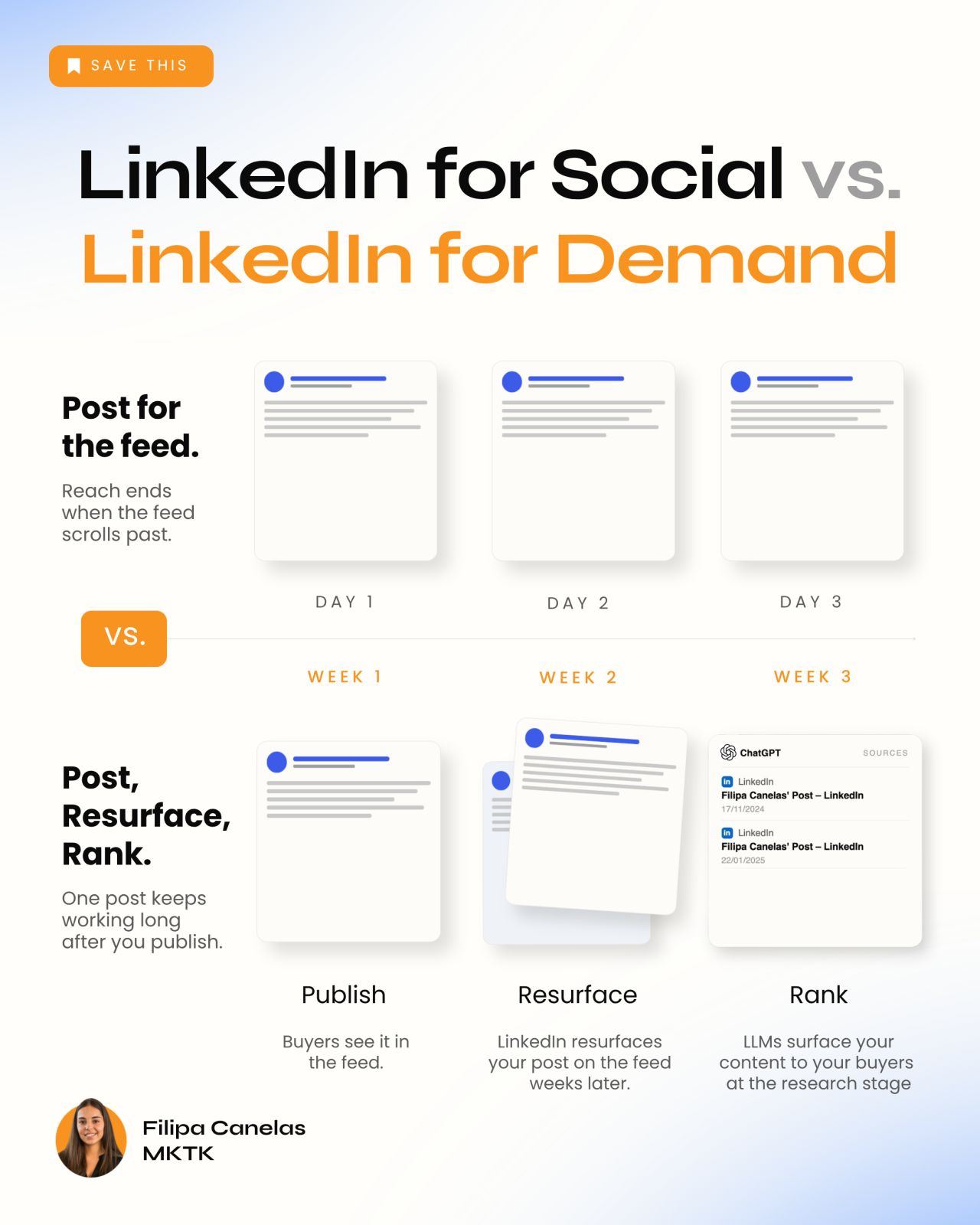
If you're measuring a CEO's LinkedIn the same way you measure a brand account (reach, likes, follower count) you're looking at the wrong scoreboard.
These social metrics matter.... they tell you whether your content is resonating. Don't ignore them but don't make it all about engagement.
These are some numbers you should look at too:
When a CEO's LinkedIn is framed as a personal brand project, it lives in the CEO's calendar assomething they have to remember to do. It competes with everything else on their plate. And when they get busy (which they always do) it dies.
When it's framed as a marketing channel, it lives in the marketing team's roadmap. It gets a brief, a strategy, an editorial calendar, and a system. The CEO approves content for fifteen minutes a week. The channel keeps running when she is on vacation.
The other thing that changes is the conversation with sales. When marketing treats the CEO's LinkedIn as a channel, they share content with SDRs for account-based sequences. They build lists of accounts that have engaged with CEO posts and prioritise them for outreach.
None of this happens when it's a personal brand. All of it is possible when it's a channel.
"Okay, Filipa. But how do we make this ours without the CEO feeling like we're taking over their voice?"
The answer is in the structure. You own the strategy, the calendar, the system, and the metrics. The CEO owns the voice, the opinions, and the final approval. Those two things are designed to work together.
The clearest framing I've found: the CEO is the talent. Marketing is the production team. The talent brings the ideas and the authenticity. The production team builds everything around it so the talent can show up for fifteen minutes and trust that the rest is handled.
When a VP of Marketing comes to me saying their CEO doesn't have time for LinkedIn, I tell them that's exactly the point. A CEO who has to find time for LinkedIn will never be consistent. A CEO who has a system built around them, with a strategist who understands their voice, a calendar that aligns with GTM priorities, and a review process that takes a few minutes, will be.
The next time you need to make this case internally, don't lead with personal brand. Lead with pipeline.
Instead, lead with:
"We want to build a CEO-led demand generation channel that reaches our ICP before the first sales touch, shortens our sales cycle, and gives us assets both marketing and sales can activate across multiple channels."
Totally different conversation... even from your CFO's perspective.
At mktk we help marketing leaders at B2B SaaS companies turn their CEO's brand into a marketing channel that supports your entire GTM strategy. If this is the conversation you're having internally right now, [book a 30 min strategy session].
.svg)